INSIGHT: GoTo Menjauhkan Pekerja Gig dari Kerja Layak dan Adil: Survei Kondisi Kerja Kurir GoKilat

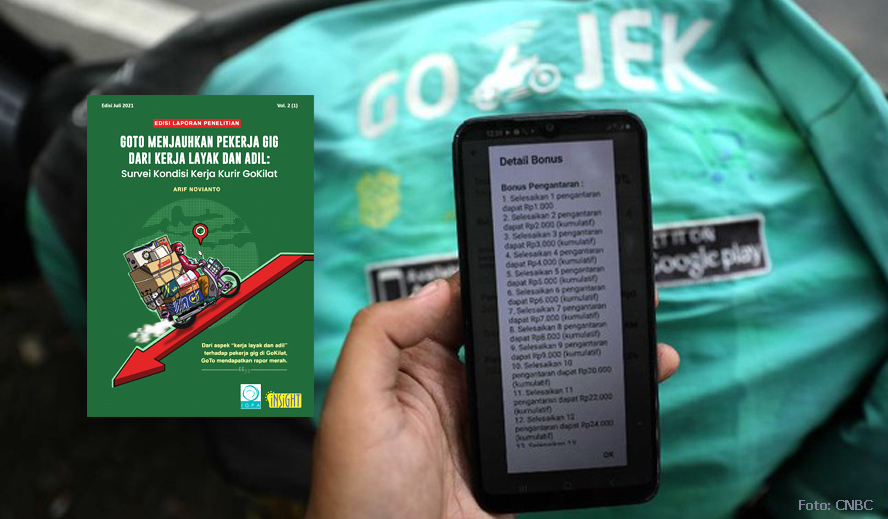
Bulletin Insight edisi Juli 2021, Volume 2 (1) kali ini menerbitkan edisi khusus berupa laporan penelitian dari Arif Novianto (Peneliti Muda di IGPA MAP Fisipol UGM) tentang kondisi kerja layak dan adil di GoKilat, sebuah layanan pengiriman barang sehari sampai dari GoTo. Berikut adalah ringkasan dalam penelitian dari Arif Novianto ini:

  • Kondisi kerja dari driver GoKilat belum berjalan sesuai dengan pekerjaan yang layak dan adil. Hal itu terlihat dari rata-rata jam kerja adalah 11,2 jam/hari, 25,2 hari/bulan, 60% kurir tidak memiliki jaminan kesehatan, 97% kurir tidak memiliki asuransi kendaraan, hubungan kemitraan yang dikuasai sepihak oleh perusahaan platform, tidak adanya jaminan pendapatan dasar, dan lain sebagainya.
  • Pendapatan dari kurir GoKilat pada Mei 2021 belum mencapai pendapatan yang layak. Dengan membandingkan dengan UMP DKI Jakarta tahun 2021, pendapatan bersih kurir GoKilat (pendapatan kotor dikurangi biaya sarana produksi dan jaminan sosial) hanya 1.661.514 rupiah per bulan (diukur berdasarkan kerja 40 jam/minggu), sedangkan UMP DKI Jakarta pada tahun 2021 sebesar 4.416.186 rupiah per bulan.
  • Dari aspek “kerja layak dan adil” terhadap pekerja gig di GoKilat, GoTo hanya mendapatkan poin 4 dari poin maksimal 15. Sehingga GoTo mendapat rapor merah “kerja layak dan adil” dalam hubungan kemitraan yang mereka jalankan di GoKilat. Bukannya berupaya memenuhi kerja layak dan adil bagi kurir GoKilat, kebijakan penurunan insentif yang ditetapkan oleh GoTo pada 08 Juni 2021 justru menjauhkan pekerja gig dari kerja layak dan adil.

Untuk membaca Bulletin Insight, Vol. 2 (1) silahkan dapat diunduh di sini: Download Bulletin Insight: GoTo Menjauhkan Pekerja Gig dari Kerja Layak dan Adil: Survei Kondisi Kerja Kurir GoKilat read more

PENGUMUMAN: Daftar Penulis dan Judul yang Terpilih dalam Buku “Menyoal Kerja Layak dan Adil dalam Ekonomi Gig di Indonesia”

Buku bunga rampai “Menyoal Kerja Layak dan Adil dalam Ekonomi Gig di Indonesia” yang akan diterbitkan oleh IGPA Press, lembaga penerbitan dari Institute of Governance and Public Affairs (IGPA) MAP Fisipol Universitas Gadjah Mada, telah sampai ke tahap berikutnya. Tim redaksi IGPA MAP Fisipol UGM telah memilih 10 abstrak dan draft tulisan dengan pertimbangan kesesuaian tema, keberagaman isu, dan analisis kritis dari total 40 abstrak dan draft tulisan yang diterima.

Dari total 40 draft naskah, kesemuanya begitu menarik, akan tetapi tidak mungkin kami menerima kesemuanya, sehingga kami memutuskan memilih 10 draft naskah sebagai berikut: read more

Call for Papers: Menyoal Kerja Layak dan Adil dalam Ekonomi Gig di Indonesia

EKONOMI GIG saat ini tengah banyak digandrungi oleh perusahaan platform, dari bidang pengantaran barang, antarpenumpang, pembuatan film, desain, konten kreatif, pekerjaan rumah tangga, hingga pengantaran makanan. Istilah kerja gig sendiri merujuk pada cara kerja musisi, bahwa mereka hanya dapat bayaran ketika ada gig atau acara manggung. Mekanisme gig tersebut, diaplikasikan secara luas dan fleksibel oleh perusahaan platform dengan menggunakan piranti teknologi digital. Di Indonesia telah ada banyak perusahaan platform yang menggunakan model ekonomi gig, baik Gojek, Grab, Marxim, InDriver, Mr Speady, Shopee Express/Food, Upwork, dan juga yang lain. read more

INSIGHT: Ketimpangan yang Dipicu BUM Desa & Dana Desa

Capaian “keberhasilan” program dana desa yang dilaksanakan pemerintah pusat sejak tahun 2015-2019 perlu kita cermati kembali. Berdasarkan data statistik yang dikeluarkan Badan Pusat Statistik (BPS) nasional menunjukkan bahwa jumlah angka kemiskinan dari tahun ke tahun menunjukkan trend penurunan. Namun, bila trend angka penurunan tersebut dicermati lebih mendalam, dibalik angka penurunan tersebut ternyata disertai dengan trend tingkat semakin parahnya kemiskinan yang juga merangkak naik tiap tahunnya. Artinya, bahwa ketimpangan dalam struktur sosial masyarakat antara kelas sosial “bawah dan atas” semakin parah terjadi. read more

Review of Draft Regulation of the Minister of Communication and Informatics on Information and Communication Technology Asset Management in Electronic-Based Government Systems

The lack of Information and Communication Technology Asset Management (ICTAM) regulations in Indonesia has resulted in the management of ICT assets both at the central and regional levels being implemented without consistent procedures and standards. As an academic institution, the Department of Management and Public Policy (DMKP) In collaboration with IGPA conducted research on ICTAM as a result of the urgent need to establish regulations relating to ICTAM in Indonesia. We help the Ministry of Communication and Information of the Republic of Indonesia to prepare academic texts for the draft of ministerial regulation relating to ICTAM according to international standards and apply adaptive principles to various conditions in Indonesia. read more

From Offline to Online: Problems and Challenges in Online Learning during the COVID-19 Pandemic

From Offline to Online: Problems and Challenges in Online Learning during the COVID-19 Pandemic

The Committee for Handling COVID-19, National Economic Recovery (KPCPEN) and the Ministry of Communication and Information (Kominfo) are collaborating with the Faculty of Social and Political Sciences Universitas Gadjah Mada in a study relating to online learning. The Faculty of Social and Political Sciences Universitas Gadjah Mada appointed IGPA as the organizer of this activity. Later, IGPA collaborated with Forbil Institute to carry out this study. read more

The Impact of COVID-19 on the Socio-Economics of Indonesia’s Vulnerable Workers

The Impact of COVID-19 on the Socio-Economics of Indonesia’s Vulnerable Workers

IGPA collaborated with the Forbil Institute conducted a preliminary study regarding the influence of social restrictions policy on the socio-economic conditions of vulnerable communities. The social restrictions policy has reduced the economic activities of the community, thereby impacting their income levels during the COVID-19 pandemic. This study used interview techniques via telephone and online platforms. We found that the COVID-19 pandemic not only caused economic vulnerability in society but also deepened economic vulnerability that existed before the pandemic and even created new vulnerable communities to emerge. This research recommends basic needs assistance policies as an alternative for COVID-19 response measures. Apart from that, efforts to formulate policies that continuously reduce socio-economic vulnerability need to be made. The results of this research were published a book “Governance for Handling COVID-19 in Indonesia: Preliminary Study (chapter 3) read more

Millennial Generation’s Perception of the National Mental Revolution Movement

Millennial Generation’s Perception of the National Mental Revolution Movement

The Coordinating Ministry for Human Development and Culture collaborated with YouSure and IGPA to carry out research entitled Millennial Generation Perception Survey of the National Mental Revolution Movement. A program developed by the elected president for 2015 – 2019 which seeks to improve people’s ethical behavior. The survey aims to determine the perceptions of millennial youth towards the National Movement for Mental Revolution. This research was performed in October-November 2017. We conducted our study in the Special Region of Yogyakarta Province by online surveys of middle school and high school students In Yogyakarta Province. We complement our study by organizing focus group discussion involving youth in Yogyakarta. The research results showed the lack of socialization of this program to the community. As a result, the proposed presidential program did not have a significant impact on improving the ethical behavior of society. read more

Social Media Literacy in Overcoming Disinformation in Gondolayu Yogyakarta

Social Media Literacy in Overcoming Disinformation in Gondolayu Yogyakarta

This community service is a downstream of an international collaborative grant research entitled ICT Development Index Indonesia (2017). This research found that the high use of ICT in Indonesia was not accompanied by the community’s ability to use ICT, which then led to the massive spread of hoax news. This community service aimed to try to solve this problem by providing social media literacy. This activity is an Empowering 8 (E8) model to provide understanding to the public about the steps to find out the truth of news which consists of Identify, Explore, Select, Organize, Create, Present, Assess, Apply. This activity was carried out in RT 1 RW 01, Kota Baru Village, Gondokusuman District, Yogyakarta City with the consideration of (1) high adoption of smartphone and social media use, high level of community plurality, and the existence of differences in political choices. The final objectives expected in this community service activity are (1) The community is able to recognize the characteristics of hoax news, (2) The community is able to check facts to prove the truth of information, and (3) The community is able to clarify the truth of information. read more

Assessing the Performance of New Provinces Decentralized Governance in Indonesia : The Case of Banten and North Kalimantan Provinces

Assessing the Performance of New Provinces Decentralized Governance in Indonesia : The Case of Banten and North Kalimantan Provinces 

Prof. Dr. Wahyudi Kumorotomo, MPP; Prof. Dr. Haryanto Dr. I Wayan Nuka Lantara, Kurnia Cahyaningrum Effendi, Dr. Terry van Dijk


IGPA received a research grant from Fisipol UGM in collaboration with the University of Groningen, Netherlands. Decentralization policy in Indonesia, since Law no. 22 of 1999, has led to increasing turmoil in the region and the formation of the New Autonomous Region. This study aims to address this gap by analyzing Banten and North Kalimantan Provinces. Both Banten and North Kalimantan are newly established regions and are still struggling with issues of identity, governance, public services, financial management and accountability. The research results show that in Banten there is a tendency for strong patterns of corruption, collusion and nepotism, as well as dynastic politics. Apart from that, spatial inequality between North and South Banten is still visible in terms of the HDI index. The problems of the new autonomous region look different from those of North Kalimantan Province. The expansion of North Kalimantan province aims to reduce the gap in the border area with Malaysia. The success of this goal can be seen from the access and infrastructure that are starting to be improved. Politics in North Kalimantan is more stable than Banten, but faces economic problems in the form of low regional revenue, declining investment trends, and quite high access gaps between district areas. read more